Tax planning is a year-round job
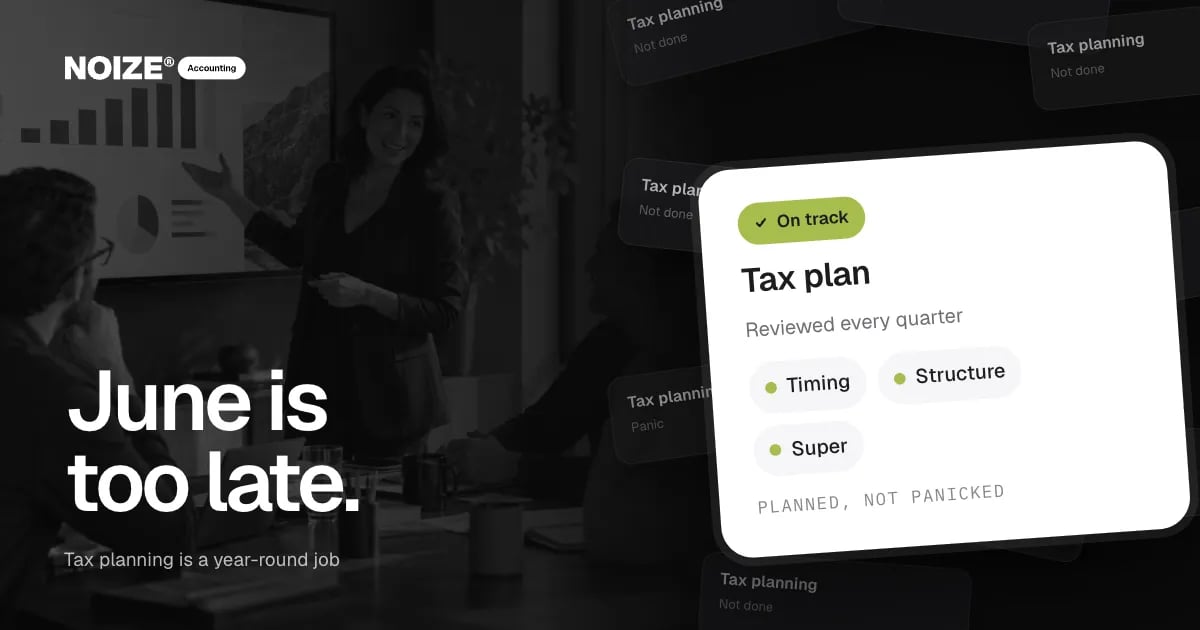
July: tax planning not done. September: not done. November: not done. February: not done. April: not done. June: panic.
For many businesses, tax planning happens in the last fortnight of the financial year. By then most of the useful options have passed. Decisions about timing, structure, purchases and superannuation work best when they are made with months to spare, not days.
The short version
- Year-round tax planning means reviewing the business's position with your accountant each quarter, so decisions about timing, structure, investment and superannuation are made while they can still change the outcome.
- It replaces the June scramble with a plan and usually leads to better, legitimate results.
- Bring current books, your plans for the year and any big decisions coming up.
- NOIZE provides administrative support and business strategy.
- Where work is outside our skillset, or the law requires it, we make sure an appropriately qualified professional is involved.
Why June is too late
01Fewer options
Many strategies need time to implement properly.
02Rushed decisions
Buying equipment or prepaying expenses just to plan for tax can harm cash flow if it isn't planned.
03Poor records
If the books aren't current, nobody knows the real position until after year-end.
04Missed structure changes
Changes to structure or ownership take planning and can't be done overnight.
What year-round planning covers
01Profit forecasting
Estimating the year's result early, so there are no surprises.
02Timing of income and expenses
Considering when to invoice, purchase or prepay, within the rules.
03Asset purchases
Planning equipment and vehicle purchases around business needs and available tax treatment.
04Superannuation
Planning contributions as part of the owner's overall position.
05Structure
Reviewing whether the business structure still suits its size and plans.
06Cash for tax
Setting aside money for tax payments so they don't create a cash squeeze.
> I've co-founded companies that learned this the expensive way. We grew fast, didn't plan, and the tax bill arrived at the worst possible moment. After that, we reviewed the position every quarter. The tax didn't disappear, but the surprises did.
“Things really got moving beyond our expectations.”
What to bring to each quarterly conversation
Current books from NOIZE Books. Your expected revenue and costs for the rest of the year. Planned purchases, hires or investments. Any changes in ownership or structure. Questions about superannuation or personal income.
An illustrative example
Imagine a profitable consultancy that finds out its tax position each September. A move to quarterly planning shows in February that profit is tracking well above last year. There is time to plan equipment purchases the business actually needs, review superannuation contributions and set aside cash for tax. June passes without panic, and the tax payment is fully funded.
Mistakes to avoid
- Don't buy things you don't need just to plan for tax.
- Don't forget that tax planning must stay within the rules.
- Don't plan tax without current books.
What we handle, and when specialists step in
For this topic, the day-to-day tasks sit with NOIZE Accounting: building forecasts, setting budgets and preparing management reports. We pair that work with advice on tax planning is a year-round job and what it means for the business.
Anything that calls for a registered tax agent goes to one of our an appropriately qualified professional. Who does what is confirmed up front, so there are no surprises.
Questions to ask each quarter
- Is the business on track against budget?
- What is the likely profit for the year?
- Are there purchases the business genuinely needs that should be timed carefully?
- Is the structure still right?
- How much should be set aside for tax?
- Are there changes in ownership, staff or plans that affect the tax position?
Bringing these questions to each meeting keeps planning practical.
What good looks like
Four planning conversations a year, each based on current books. A profit estimate that firms up as the year progresses. Purchases planned around real business needs. Cash set aside for tax so payments don't cause stress. Structure reviewed as the business grows. June becomes a routine month, not a deadline scramble.
Where to start this week
Book a short meeting with your accountant now, not in June. Bring your year-to-date figures and your plans for the next six months. See accounting.noize.com.au.
How Accounting connects to the rest of NOIZE
The value grows when this department works alongside the rest of the group. NOIZE Strategy sets the priorities, and Accounting costs them and tests what the business can afford. NOIZE Finance uses Accounting's statements and forecasts to prepare a funding pack that makes the broker's job easy. NOIZE Legal works with Accounting on structure. Where the law requires a registered tax agent, an appropriately qualified professional step in. Together, the numbers support every major decision the business makes. NOIZE Books keeps the records current so advice is based on this month, not last year.
Related reading
This article is general information only. It is not legal, tax or financial advice, and it does not take your circumstances into account. Speak to a qualified adviser before acting.
NOIZE provides administrative support and business strategy. Where work is outside our skillset, or the law requires it, we make sure an appropriately qualified professional is involved.
Common questions
When should small businesses do tax planning?
Throughout the year, ideally quarterly, rather than only before 30 June.
Is tax planning legal?
Yes, when it uses legitimate strategies within the tax rules. Your accountant will advise on what applies to you.
Should I buy equipment before 30 June to plan for tax?
Only if the business genuinely needs it and the cash flow suits. Plan it rather than rushing.
How do I know how much tax to set aside?
A profit forecast and regular reviews give a reliable estimate.
Does business structure affect tax?
Yes. Structure is reviewed as part of planning.
What records do I need?
Current, reconciled books and your plans for the year.
Can superannuation be part of tax planning?
Often, as part of the owner's overall position. Your accountant will advise.
Can NOIZE do our tax planning?
Yes. NOIZE Accounting provides year-round planning, with tax compliance handled directly or through an appropriately registered professional.
Is NOIZE Accounting a registered tax agent?
We handle planning, reporting and strategy directly. Where the law requires a registered tax agent, an appropriately qualified professional is involved.
What records do I need for tax planning?
Current, reconciled books and your plans for the rest of the year.
Who lodges the tax return?
Tax returns are lodged directly or through an appropriately registered professional where the law requires it.
Can you help us set prices?
Yes. Accounting can analyse costs and margins to support pricing decisions.
Do you work with businesses across Australia?
Yes. Most accounting work can be done remotely, wherever the business is based.
How do we start with NOIZE Accounting?
Bring your last set of accounts and the decision you are trying to make.
What is budgeting?
Setting expected income and spending for a period, so results can be measured against a plan.
What is management accounting?
Reporting and analysis designed to help run the business, rather than to meet compliance requirements.
Can tax planning help with cash flow?
Yes. Knowing the likely tax bill early means cash can be set aside gradually.
Your first strategy conversation is on us.
Have a chatThe brand for business.