Pricing and hiring on evidence: using a forecast for big calls
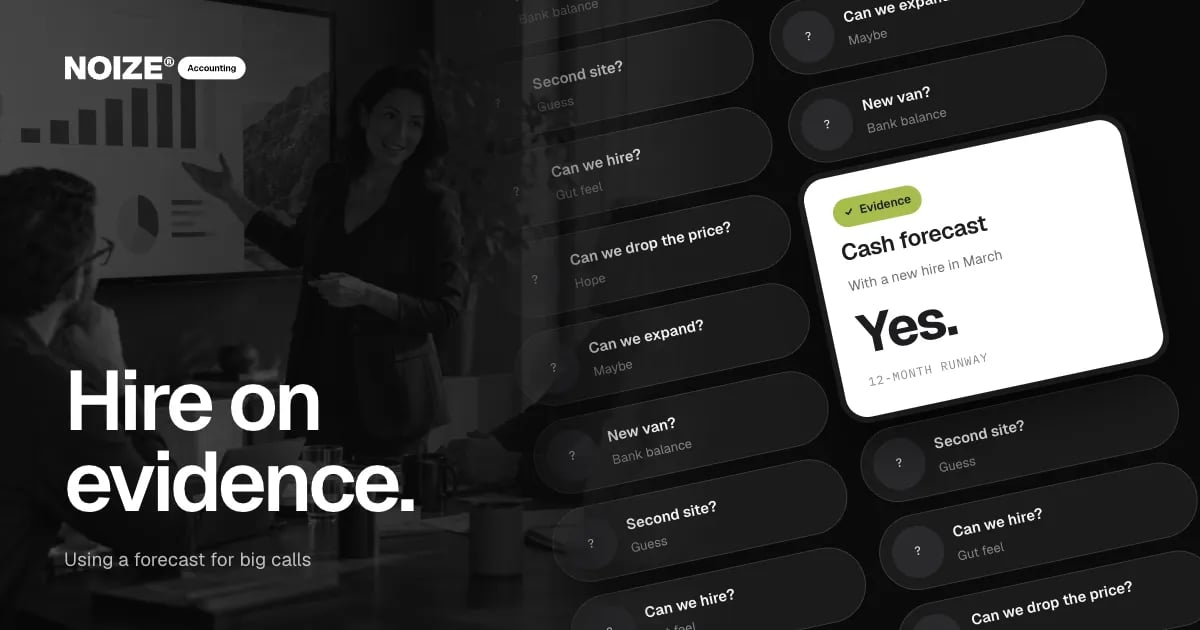
- Can we hire someone?
- Can we drop the price to win that contract?
- Can we open a second site?
- Can we buy the new van?
Gut feel says yes. Hope says it will work out. Maybe. The bank balance looks fine today.
No forecast, just a bank balance. Many owners make their biggest decisions this way. It works until the timing goes wrong: the hire starts just as a tax payment falls due, or the new site opens in the quietest month of the year.
The short version
- "Can I afford to hire?" is one of the most common questions a forecast answers.
- A cash-flow forecast estimates money coming in and going out over the next twelve months.
- It shows when cash will be tight and when there is room to invest.
- Add scenarios, such as a new hire, a price change or a new site, and big decisions become questions of evidence rather than instinct.
- Update it monthly against actual results.
- NOIZE provides administrative support and business strategy.
- Where work is outside our skillset, or the law requires it, we make sure an appropriately qualified professional is involved.
What a cash-flow forecast shows
01Expected income
Sales, collections from customers and other receipts, timed when cash actually arrives.
02Expected costs
Wages, rent, suppliers, loan repayments, tax and other payments, timed when they leave.
03Closing cash each month
The balance you can expect at the end of each month.
04Pinch points
Months where cash dips, so you can plan ahead.
Decisions a forecast can answer
- Can we afford to hire? Add the salary and on-costs from the start date and see the effect on cash.
- What if we change prices? Model the impact on revenue and margin.
- Can we expand? Add fit-out, extra costs and ramp-up revenue for a new site.
- Should we buy or finance equipment? Compare the cash impact of each.
- What if a big customer pays late? See how long the business can absorb the delay.
Scenario planning
A good forecast isn't one prediction. It includes a likely case, a cautious case and an optimistic case. Seeing all three helps owners make decisions that work across a range of outcomes and plan responses before they are needed.
> I've invested in dozens of ventures, and the founders I trust most can tell me what happens to their cash if sales drop by a fifth. They have already run the numbers. That preparation is worth more than any confident pitch.
“Things really got moving beyond our expectations.”
Keeping the forecast useful
Update it monthly with actual results. Compare forecast with actual and learn from the differences. Review assumptions when something significant changes. A forecast that is updated regularly gets more accurate over time and becomes one of the most valuable tools in the business.
An illustrative example
Picture a services business wanting to hire two people in March. The forecast shows that combined with a BAS payment and a slow April, cash would dip uncomfortably low. Staggering the hires a month apart and tightening collections on two large debtors keeps cash healthy. Both hires go ahead, just not at the same time.
Mistakes to avoid
- Don't confuse profit with cash. A profitable month can still be a tight cash month.
- Don't build a forecast once and forget it.
- Don't ignore tax, loan repayments and annual costs.
How NOIZE Accounting works with you
Most of what this article covers is practical work NOIZE Accounting takes on: modelling decisions, reviewing margins and pricing and planning cash flow. You get our view on pricing and hiring on evidence too, not just the paperwork.
If a job needs a registered tax agent, we involve an appropriately qualified professional with the right accreditation. The right mix is decided with you when we scope the work.
Some clients want everything handled, others want a second set of eyes. Both work, and the arrangement can change as the business does.
Questions a forecast can answer
- When will cash be tightest this year?
- Can we afford a new hire, and from when?
- What happens if our biggest customer pays late?
- How much can we spend on marketing this quarter?
- When would a second location become affordable?
- What if sales grow faster than expected?
Each of these is a real decision, and each is easier with a forecast in hand.
What good looks like
A twelve-month cash-flow forecast built from current books, with likely, cautious and optimistic cases. It is updated monthly against actual results. Big decisions are modelled before they are made. Pinch points are visible months ahead, giving time to plan. Lenders and partners receive a forecast that holds up to scrutiny.
Where to start this week
Write down your expected cash in and out for each of the next three months, including tax and annual bills. Even a rough version will show where the pressure points are. See accounting.noize.com.au and books.noize.com.au.
How Accounting connects to the rest of NOIZE
Here is how the other departments support this work. NOIZE Finance uses Accounting's statements and forecasts to prepare a funding pack that makes the broker's job easy. NOIZE Legal works with Accounting on structure. Where the law requires a registered tax agent, an appropriately qualified professional step in. Together, the numbers support every major decision the business makes. NOIZE Books keeps the records current so advice is based on this month, not last year. NOIZE Strategy sets the priorities, and Accounting costs them and tests what the business can afford.
Related reading
This article is general information only. It is not legal, tax or financial advice, and it does not take your circumstances into account. Speak to a qualified adviser before acting.
NOIZE provides administrative support and business strategy. Where work is outside our skillset, or the law requires it, we make sure an appropriately qualified professional is involved.
Common questions
What is a cash-flow forecast?
An estimate of money coming in and going out over a future period, usually twelve months.
How is a forecast different from a budget?
A budget sets targets for income and spending. A forecast predicts actual cash movements and is updated as things change.
How often should a forecast be updated?
Monthly, comparing it with actual results.
Can a forecast tell me if I can afford to hire?
Yes. It shows the cash impact of the new salary and on-costs over time.
What is scenario planning?
Modelling different possible outcomes, such as cautious and optimistic cases, to plan responses.
Do I need current books for a forecast?
Yes. Current records make the starting point accurate.
Can lenders use my forecast?
Yes. Forecasts are often part of funding applications.
Can NOIZE build our forecast?
Yes. NOIZE Accounting builds and maintains cash-flow forecasts.
Is NOIZE Accounting a registered tax agent?
We handle planning, reporting and strategy directly. Where the law requires a registered tax agent, an appropriately qualified professional is involved.
How accurate can a forecast be?
No forecast is perfect, but updating it monthly against actual results makes it steadily more reliable.
Can a forecast help with pricing?
Yes. It shows how price changes affect revenue, margin and cash over time.
Do you work with businesses across Australia?
Yes. Most accounting work can be done remotely, wherever the business is based.
How do we start with NOIZE Accounting?
Bring your last set of accounts and the decision you are trying to make.
Your first strategy conversation is on us.
Have a chatThe brand for business.